Desk Q&A
The Echo Weapon Desk Q&A: Premise, Reader Fit, and Influences
This is an editorial Q&A built from the public book description, sample chapters, and comparison shelf. It is not a private interview and it does not invent author quotes.
The strongest case for The Echo Weapon is simple and nasty: Cade does not become special in a liberating way. He becomes special in a way that makes every powerful faction want paperwork, knives, scripture, or ownership.
What kind of piece is this?
A review-desk Q&A, not a fake interview.
Best for
Science fiction readers who want the idea to hurt the world around it: alien infrastructure, empire, body alteration, military use, religious machinery, and a new series starting before consensus has settled.
Core promise
Humanity chained the Vigil, built an empire on it, and Cade’s buried Echo wakes while the god-machine is no longer staying quiet.
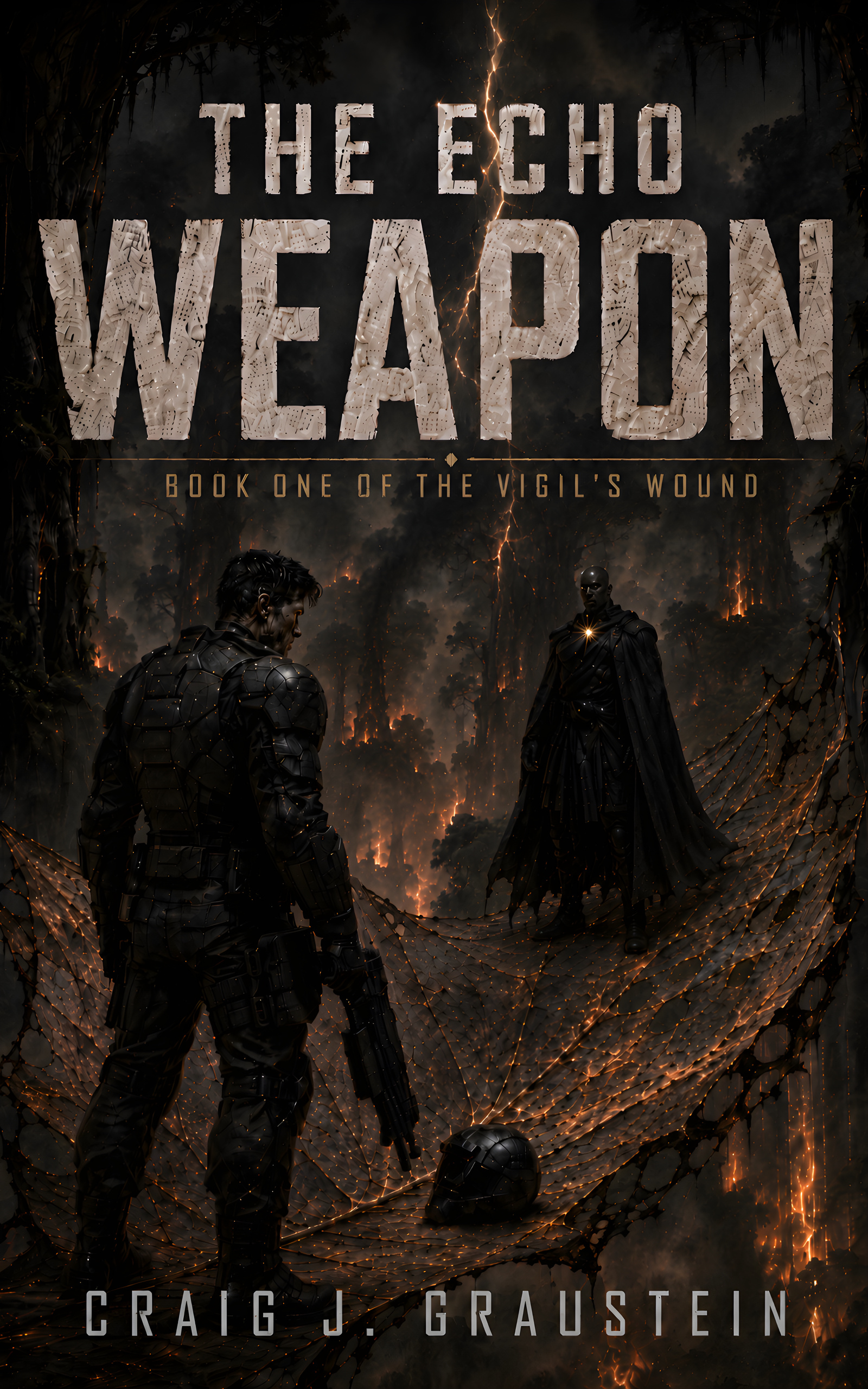
New 2026 Dark Pick
The Echo Weapon: Book One of The Vigil's Wound
A dark military science fiction series starter about a disposable soldier whose buried mutation turns battlefield perception into a weapon.
- dark military science fiction
- military space opera
- squad combat sci-fi
- super soldier science fiction
- genetic mutation science fiction
Why start with the chained god instead of the soldier?
Because the chained god tells the reader what kind of universe this is before anybody fires a rifle. Humanity did not merely find a fast road between stars. It built a Dominion on a wounded intelligence and then learned to call that dependence civilization.
That is the good hook. The Vigil is not background lore sitting in a museum case. It is altar, engine, prison, road system, and old mind waking under the floor. When Cade’s Echo appears, it matters because the body-level problem is connected to the cosmic crime.
What makes Cade more than another special recruit?
The difference is ownership. A cheap power fantasy gives the recruit a hidden upgrade and lets the plot applaud. The Echo does the opposite. It makes Cade harder to ignore, harder to protect, harder to classify, and harder to keep human in the eyes of people who specialize in turning humans into assets.
That is why "disposable meat" is the right starting temperature. Cade’s value rises before his freedom does. The more useful he becomes, the more dangerous the room becomes around him.
Where the military story earns trust
The sample matters because it does not float above the mud. It gives the reader cold work, equipment checks, squad voice, boredom, irritation, discipline, and the kind of military routine that lets horror enter through a job instead of a prophecy speech.
That ground texture is the thing a lot of genre pages skip. You can promise god-machine scale all day. The reader trusts it only when the boots, weapons, jokes, fear, and chain of command feel like they belong to people who have to survive the next hour.
What the neighboring shelf clarifies
The neighbors are useful only when they clarify function. Dune helps with sacred infrastructure. The Expanse helps with consequence. Red Rising helps with violent transformation. Revelation Space helps with cold ancient dread. The Echo Weapon has to be judged where those appetites overlap without turning into a cover band.
The useful question is not "is this exactly like that other famous book?" That is a lazy comparison. The useful question is which appetite carries over: transformation, sacred infrastructure, squad pressure, alien dread, empire, found loyalty, or the body becoming contested ground.
Where the book should not be oversold
Do not call it a proven classic. Do not pretend reader consensus exists before the reader base has had time to form. Do not flatten it into "Red Rising meets Warhammer 40,000" and walk away as if that solved the pitch.
The better sell is narrower and stronger: a dark military science fiction opener where a cadet’s mutation ties squad survival to alien god-machinery and imperial ownership. That tells the right reader what the book is actually offering.
The specific angle for this site
The science-fiction hook is not simply that a god-machine exists. It is that civilization has normalized using a chained intelligence as infrastructure, and Cade’s body starts to prove the infrastructure is not dead.
That angle should stay visible across the page. The best authority sites do not shout the same tagline forever. They keep returning to the book from different reader problems until the shape becomes obvious.
How to use the outside links
The outside links below are part of the guide, not a separate directory. Use them to verify named books and series, follow current genre conversation, compare the page against review outlets and podcasts, and see how readers discuss the same appetite in public communities.